The main difference between Cloning vs. Subcloning is that cloning is the process of creating multiple copies of a DNA fragment, gene, or other genetic material by inserting it into a cloning vector and propagating it in a host organism, whereas subcloning is the process of transferring an already cloned DNA fragment from one vector (parent vector) into another vector (destination vector) for further analysis, protein expression, or genetic modification.
Understanding the difference between Cloning vs. Subcloning is important for students, molecular biologists, genetic engineers, and biotechnology researchers because both techniques are fundamental tools in recombinant DNA technology. While cloning is used to obtain and amplify a DNA sequence of interest, subcloning allows scientists to modify, express, or further investigate that DNA by placing it into a more suitable vector.
Cloning vs. Subcloning: Comparison Table
The table below highlights the major differences between Cloning vs. Subcloning.
| Feature | Cloning | Subcloning |
|---|---|---|
| Definition | Process of producing copies of a DNA fragment or gene | Process of transferring a cloned DNA fragment from one vector to another |
| Main Objective | Obtain multiple copies of DNA | Modify or further utilize an existing clone |
| Starting Material | Original DNA, cDNA, or genomic DNA | Previously cloned DNA fragment |
| DNA Insert | New DNA fragment | Existing cloned insert |
| Parent Vector | Not required initially | Required |
| Destination Vector | Cloning vector | Expression vector or another specialized vector |
| Common Vectors | Plasmids, bacteriophages, BACs, YACs | Expression vectors, shuttle vectors, viral vectors |
| Complexity | More complex | Comparatively simpler |
| Time Required | Longer | Usually shorter |
| DNA Manipulation | Initial insertion of DNA | Transfer of DNA between vectors |
| Typical Applications | Gene cloning, DNA library construction, recombinant DNA production | Protein expression, gene function studies, mutagenesis |
| Molecular Biology Step | Primary cloning | Secondary cloning |
| Research Purpose | DNA amplification | DNA modification or specialized expression |
| Cost | Generally higher | Usually lower |
| Importance | Foundation of recombinant DNA technology | Essential for advanced genetic engineering |
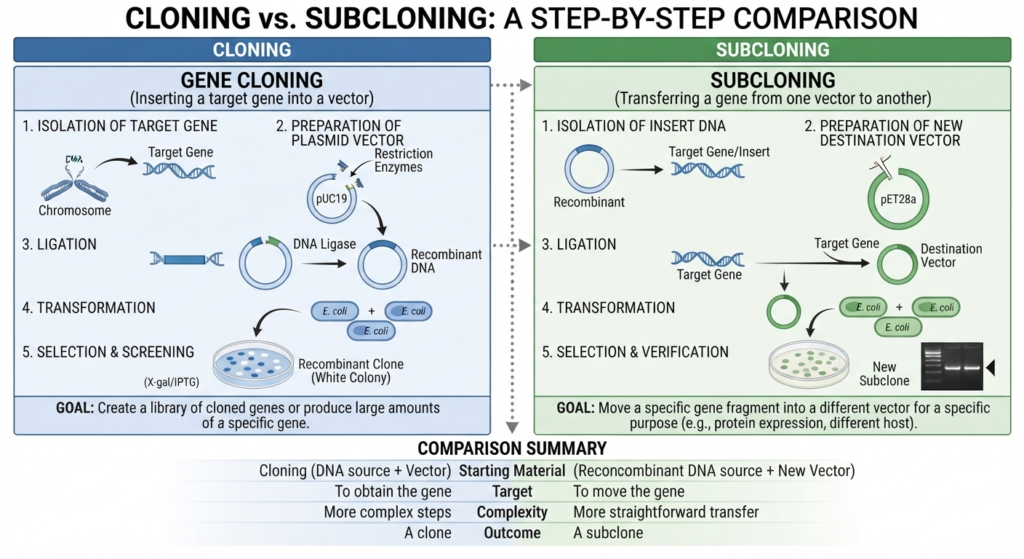
What Is Cloning?
Cloning is a molecular biology technique used to produce multiple identical copies of a specific DNA fragment, gene, or genetic sequence. In molecular cloning, the DNA of interest is inserted into a cloning vector, such as a plasmid, which is then introduced into a host organism—commonly Escherichia coli (E. coli). As the host cells multiply, they replicate the inserted DNA, producing millions of identical copies.
Molecular cloning is one of the most important techniques in modern biotechnology. It enables scientists to isolate genes, study gene function, produce recombinant proteins, develop genetically modified organisms (GMOs), create DNA libraries, and manufacture therapeutic proteins such as insulin and growth hormones.
Although the term cloning can also refer to cloning entire cells or organisms, in molecular biology it most commonly describes the cloning of DNA fragments.
Key Characteristics of Cloning
- Produces multiple identical copies of a DNA fragment or gene
- Begins with original genomic DNA or complementary DNA (cDNA)
- Uses cloning vectors such as plasmids or bacteriophages
- Requires insertion of DNA into a host organism
- Involves restriction enzymes and DNA ligase
- Amplifies DNA for research and industrial applications
- Forms the basis of recombinant DNA technology
- Used in genetic engineering, medicine, agriculture, and biotechnology
- Essential for DNA library construction
- Supports large-scale production of recombinant proteins
What Is Subcloning?
Subcloning is a molecular biology technique in which a DNA fragment that has already been cloned into one vector is transferred into a different vector for a specific experimental purpose. Instead of cloning DNA directly from its original source, subcloning uses an existing recombinant DNA molecule as the starting material.
Researchers commonly perform subcloning when they need to express a gene in a different host organism, place the gene under a stronger promoter, add purification tags, introduce mutations, or carry out functional studies. The DNA insert is first removed from the parent vector using restriction enzymes and then ligated into a prepared destination vector.
Subcloning is widely used in recombinant protein production, gene expression analysis, vaccine development, synthetic biology, and pharmaceutical research. Because the DNA sequence has already been cloned, subcloning is generally faster and more straightforward than the initial cloning process.
Key Characteristics of Subcloning
- Transfers an existing DNA insert from one vector to another
- Uses a previously cloned DNA fragment
- Requires both a parent vector and a destination vector
- Often employs expression vectors for protein production
- Involves restriction digestion and DNA ligation
- Enables further manipulation of cloned genes
- Supports recombinant protein expression
- Commonly used in genetic engineering and biotechnology
- Usually faster than primary cloning
- Ideal for downstream molecular biology applications
Cloning vs. Subcloning: Key Differences
1. Definition
Although cloning and subcloning are closely related molecular biology techniques, they serve different purposes.
Cloning is the process of inserting a DNA fragment, gene, or complementary DNA (cDNA) into a cloning vector to produce multiple identical copies. It is usually the first step in recombinant DNA technology and allows researchers to amplify a DNA sequence for further study.
Subcloning, in contrast, involves transferring an already cloned DNA fragment from a parent vector into another vector. This enables researchers to perform specialized applications such as protein expression, gene analysis, mutagenesis, or functional studies.
In simple terms, cloning creates the initial DNA clone, while subcloning modifies or relocates that existing clone for a new purpose.
2. Purpose
The primary objectives of cloning and subcloning are different.
The purpose of cloning is to isolate and amplify a DNA fragment so that sufficient copies are available for research, sequencing, genetic engineering, or recombinant protein production.
Subcloning is performed after cloning when researchers need to transfer the DNA insert into a vector with different characteristics. This may include stronger promoters, selectable markers, fusion tags, or specialized expression systems.
Thus, cloning focuses on DNA amplification, whereas subcloning focuses on further utilization of an existing DNA clone.
3. Starting Material
One of the key differences between Cloning vs. Subcloning is the type of DNA used at the beginning of the experiment.
Cloning typically starts with original genetic material such as:
- Genomic DNA
- Complementary DNA (cDNA)
- PCR-amplified DNA
- Synthetic DNA fragments
Subcloning, however, begins with a DNA fragment that has already been cloned into a parent vector. Instead of isolating DNA again, researchers simply excise the existing insert and transfer it into another vector.
Because the desired DNA has already been obtained, subcloning usually requires fewer experimental steps.
4. Vectors Used
Both techniques require vectors, but the types of vectors commonly used are different.
Cloning generally uses vectors designed for efficient DNA replication, including:
- Plasmid vectors
- Bacteriophage vectors
- Cosmids
- BACs (Bacterial Artificial Chromosomes)
- YACs (Yeast Artificial Chromosomes)
Subcloning often transfers the DNA insert into specialized vectors such as:
- Expression vectors
- Shuttle vectors
- Viral vectors
- Reporter vectors
- Gateway vectors
The destination vector is selected according to the experimental objective, such as protein expression, fluorescent labeling, or gene regulation studies.
5. Process
Although both methods involve recombinant DNA technology, their workflows differ.
The cloning process generally includes:
- Isolation of the DNA fragment
- Restriction enzyme digestion
- Preparation of the cloning vector
- DNA ligation
- Transformation into competent host cells
- Screening and selection of recombinant colonies
Subcloning follows a shorter workflow because the DNA insert has already been cloned:
- Isolation of the parent plasmid
- Removal of the desired DNA insert using restriction enzymes
- Preparation of the destination vector
- Ligation of the insert into the new vector
- Transformation into host cells
- Screening for successful subclones
Overall, subcloning eliminates the need to isolate the original DNA source, making it more efficient.
6. Complexity
Cloning is generally more complex because it begins with the original DNA sample. Researchers must identify, isolate, amplify, and successfully insert the target DNA into a suitable vector before confirming the recombinant clone.
Subcloning is comparatively simpler since the DNA sequence has already been cloned and verified. The primary task is transferring the insert from one vector to another, reducing both experimental complexity and the chances of cloning errors.
However, subcloning can become more challenging if multiple restriction sites, fusion proteins, or specialized expression systems are involved.
7. Time Required
The time required for cloning and subcloning differs considerably.
Initial cloning usually takes longer because it involves DNA isolation, PCR amplification (if required), vector preparation, ligation, bacterial transformation, colony screening, and sequence verification.
Subcloning is generally faster because researchers work with an existing recombinant plasmid. Once the insert is excised from the parent vector, it can be transferred directly into the destination vector, reducing the overall experimental time.
For this reason, subcloning is often preferred when multiple expression vectors or host systems need to be tested.
8. Applications
Although both techniques are widely used in molecular biology, their applications differ according to the research objective.
Common applications of cloning include:
- Gene isolation
- DNA library construction
- Gene sequencing
- Recombinant DNA production
- Production of therapeutic proteins
- Development of genetically modified organisms (GMOs)
- Genetic engineering research
- Molecular diagnostics
Common applications of subcloning include:
- Recombinant protein expression
- Gene function analysis
- Reporter gene assays
- Site-directed mutagenesis
- Protein purification using affinity tags
- Vaccine development
- Synthetic biology
- Functional genomics
In general, cloning establishes the DNA construct, while subcloning adapts that construct for specialized experimental applications.
9. Advantages
Both techniques provide important benefits in molecular biology, but their strengths differ.
Advantages of cloning include:
- Produces stable copies of DNA fragments
- Enables long-term storage of genetic material
- Supports large-scale DNA amplification
- Forms the foundation of recombinant DNA technology
- Essential for genome and cDNA library construction
Advantages of subcloning include:
- Faster than repeating the cloning process
- Allows easy transfer of genes into specialized vectors
- Supports protein expression in different host organisms
- Facilitates gene modification and functional analysis
- Reduces time and laboratory costs for downstream experiments
The choice between cloning and subcloning depends on whether the goal is to create an initial DNA clone or to further manipulate an existing one.
10. Limitations
Like any laboratory technique, both cloning and subcloning have certain limitations.
Limitations of cloning include:
- More time-consuming than subcloning
- Requires isolation of the original DNA fragment
- Higher experimental cost
- Greater chance of cloning failures during the initial stages
- Requires extensive screening to identify successful clones
Limitations of subcloning include:
- Depends on the availability of a previously cloned DNA fragment
- May require compatible restriction enzyme sites
- Incorrect vector selection can reduce gene expression
- Additional verification is needed after DNA transfer
- Multiple subcloning steps can increase the risk of unwanted mutations
Understanding these limitations helps researchers choose the most appropriate technique for their experimental goals.
Similarities Between Cloning and Subcloning
Although cloning and subcloning are distinct molecular biology techniques, they share several important characteristics because both involve the manipulation of DNA using recombinant DNA technology.
Some of the major similarities include:
- Both are fundamental techniques in molecular biology and genetic engineering.
- Both involve the manipulation of DNA fragments.
- Both use vectors to carry DNA into host cells.
- Both commonly employ plasmids as cloning vehicles.
- Both rely on restriction enzymes and DNA ligase.
- Both require transformation into competent host cells, usually bacteria.
- Both involve screening and selection of successful recombinant clones.
- Both are widely used in biotechnology, medicine, and research laboratories.
- Both help produce recombinant DNA molecules.
- Both are essential for studying gene structure and function.
Despite these similarities, cloning is used to generate the initial DNA clone, whereas subcloning modifies or transfers an existing clone for specialized applications.
Advantages and Uses of Cloning
Cloning is one of the most important techniques in modern biotechnology because it allows scientists to isolate, amplify, and preserve specific DNA sequences for a wide variety of applications.
Some of the major advantages and uses of cloning include:
- Produces multiple identical copies of a DNA fragment.
- Enables long-term storage of genes in cloning vectors.
- Facilitates DNA sequencing and genome analysis.
- Supports the construction of genomic and cDNA libraries.
- Used in recombinant protein production, including insulin and growth hormone.
- Essential for developing genetically modified organisms (GMOs).
- Assists in gene discovery and functional genomics.
- Plays a key role in gene therapy research.
- Supports vaccine development and pharmaceutical research.
- Widely used in agricultural biotechnology to improve crop traits.
- Helps investigate inherited diseases and genetic disorders.
- Forms the foundation of recombinant DNA technology.
Because of its versatility, cloning has become an indispensable tool in genetics, biotechnology, medicine, and life science research.
Advantages and Uses of Subcloning
Subcloning is especially valuable when researchers need to transfer an existing DNA fragment into a vector designed for a specific experimental purpose.
Major advantages and uses of subcloning include:
- Transfers genes into specialized expression vectors.
- Enables efficient recombinant protein production.
- Facilitates gene expression studies in different host organisms.
- Allows the addition of affinity or fluorescent tags to proteins.
- Supports site-directed mutagenesis and gene modification.
- Used in reporter gene assays to study promoter activity.
- Simplifies protein purification experiments.
- Helps optimize gene expression using different promoters.
- Supports synthetic biology and metabolic engineering.
- Reduces the need to repeat the entire cloning process.
- Saves laboratory time and research costs.
- Widely used in pharmaceutical and biotechnology industries.
Subcloning provides researchers with greater flexibility by allowing the same DNA insert to be used in multiple experimental systems.
Laboratory Considerations
Both cloning and subcloning require careful laboratory practices to ensure accurate and reproducible results.
When performing these techniques, researchers should follow these general guidelines:
- Maintain sterile working conditions to prevent contamination.
- Use high-quality DNA samples and purified vectors.
- Select appropriate restriction enzymes and compatible cloning sites.
- Verify DNA insert orientation before downstream experiments.
- Use competent host cells with high transformation efficiency.
- Confirm recombinant clones by PCR, restriction digestion, or DNA sequencing.
- Store recombinant plasmids under recommended laboratory conditions.
- Follow institutional biosafety guidelines when handling genetically modified organisms.
- Properly dispose of biological waste and chemical reagents.
- Record experimental procedures carefully to ensure reproducibility.
Careful planning and validation at each step significantly improve the success rate of both cloning and subcloning experiments.
Which Technique Is Better?
Neither cloning nor subcloning is universally better because each technique serves a different purpose in molecular biology.
Cloning is the preferred choice when researchers need to isolate a gene or DNA fragment from its original source and generate multiple identical copies. It serves as the starting point for many genetic engineering and recombinant DNA experiments.
Subcloning, however, becomes the better option once the desired DNA has already been cloned. It allows scientists to transfer the DNA into specialized vectors for protein expression, gene regulation studies, mutagenesis, or other advanced applications without repeating the entire cloning process.
In practice, these techniques complement one another rather than compete. Cloning establishes the original recombinant DNA construct, while subcloning expands its usefulness by adapting it for different research and industrial purposes.
Conclusion
The comparison of Cloning vs. Subcloning shows that although both techniques are essential components of recombinant DNA technology, they serve different purposes in molecular biology. Cloning is the process of creating multiple copies of a DNA fragment by inserting it into a cloning vector and propagating it in a host organism. It is the first step in many genetic engineering experiments and provides researchers with sufficient DNA for analysis, sequencing, and genetic manipulation.
Subcloning, on the other hand, involves transferring an already cloned DNA fragment from a parent vector into another vector designed for a specific application, such as protein expression, gene function analysis, or mutagenesis. Since the DNA has already been cloned, subcloning is generally faster and more efficient than repeating the cloning process.
Understanding the differences between Cloning vs. Subcloning helps students, researchers, and biotechnology professionals select the appropriate technique for DNA amplification, recombinant protein production, gene expression studies, and advanced genetic engineering applications.
Frequently Asked Questions (FAQs)
The main difference between Cloning vs. Subcloning is that cloning creates the initial copies of a DNA fragment by inserting it into a vector, whereas subcloning transfers an already cloned DNA fragment from one vector to another for further research or specialized applications.
Yes. Subcloning is considered a specialized form of molecular cloning in which an existing DNA insert is transferred into a different vector instead of cloning DNA directly from its original source.
Subcloning is performed to place a DNA fragment into a vector that is better suited for a specific purpose, such as recombinant protein expression, promoter analysis, fluorescent labeling, or site-directed mutagenesis.
Cloning is generally more complex because it starts with the original DNA sample and requires DNA isolation, vector construction, and clone verification. Subcloning is usually simpler because it uses a previously cloned DNA fragment.
Yes. In many molecular biology experiments, cloning is performed first to obtain the desired DNA fragment. Subcloning is then used to transfer that DNA into another vector optimized for expression, analysis, or further genetic modification.
References:
1. “Common Cloning Applications and Strategies.” Thermo Fisher Scientific – US
Read Next:
- Difference Between Ingroup and Outgroup in Biology
- XX vs. XY Chromosome: What’s the Difference?
- Difference Between Hemolysis and Crenation
- Difference Between Apheresis and Dialysis
- Difference Between Male and Female Sternum
- Female Clavicle vs. Male Clavicle: What’s the Difference?
- Chemoorganotrophs vs. Chemolithotrophs
- Acantholysis vs. Acanthosis
- Lacunae vs. Lamellae