The main difference between 1-Butene vs. 2-Butene is that 1-butene has its carbon-carbon double bond at the end of the carbon chain (between the first and second carbon atoms), whereas 2-butene has the double bond in the middle of the chain (between the second and third carbon atoms). This difference in double-bond position affects their structure, stability, reactivity, isomerism, and industrial applications. While both compounds share the molecular formula C₄H₈ and belong to the alkene family, they exhibit distinct chemical behaviors and are used for different manufacturing purposes.
Understanding the difference between 1-butene and 2-butene is important for chemistry students, researchers, and professionals working in the petrochemical and polymer industries because these two structural isomers serve as valuable raw materials for plastics, synthetic rubber, fuels, and specialty chemicals.
1-Butene vs. 2-Butene: Comparison Table
The table below highlights the major differences between 1-Butene and 2-Butene.
| Feature | 1-Butene | 2-Butene |
| Chemical Formula | C₄H₈ | C₄H₈ |
| Structural Formula | CH₂=CH–CH₂–CH₃ | CH₃–CH=CH–CH₃ |
| Type of Compound | Alkene | Alkene |
| Double Bond Position | Between C1 and C2 | Between C2 and C3 |
| Isomer Type | Terminal alkene | Internal alkene |
| Molecular Mass | 56.11 g/mol | 56.11 g/mol |
| Geometrical Isomers | Not possible | Cis and Trans isomers |
| Stability | Less stable | More stable |
| Reactivity | Higher | Lower |
| Main Industrial Use | Polyethylene production | Butadiene and solvent production |
| Appearance | Colorless gas | Colorless gas |
| Flammability | Highly flammable | Highly flammable |
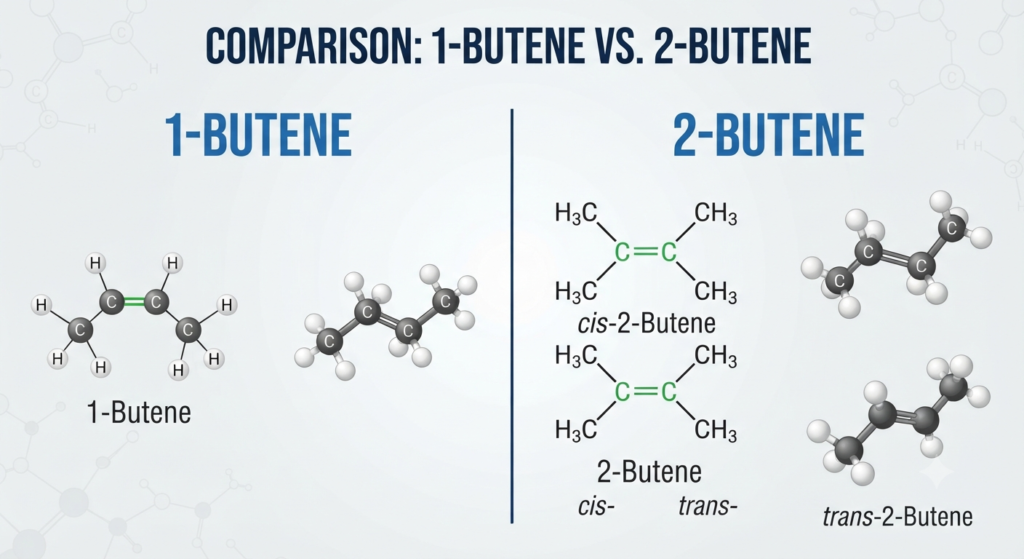
What Is 1-Butene?
1-Butene is a four-carbon alkene with the molecular formula C₄H₈. In this compound, the carbon-carbon double bond is located at the end of the carbon chain, between the first and second carbon atoms. Because the double bond is terminal, it is classified as a terminal alkene (alpha-olefin).
At room temperature, 1-butene exists as a colorless, highly flammable gas with a mild hydrocarbon odor. It is produced mainly during petroleum refining and steam cracking processes and is an important feedstock in the petrochemical industry.
One of the most significant applications of 1-butene is in the manufacture of linear low-density polyethylene (LLDPE) and high-density polyethylene (HDPE). It is also used to produce synthetic lubricants, plastic additives, and various industrial chemicals.
Key Characteristics of 1-Butene
- Molecular formula: C₄H₈
- Terminal double bond
- Classified as an alpha-olefin
- Colorless and highly flammable gas
- Important raw material for polyethylene production
- More reactive because of its terminal double bond
What Is 2-Butene?
2-Butene is another structural isomer of butene having the same molecular formula (C₄H₈) but a different arrangement of atoms. Unlike 1-butene, the double bond is positioned between the second and third carbon atoms, making it an internal alkene.
A unique feature of 2-butene is that it exists in two geometrical (stereoisomeric) forms:
- Cis-2-butene
- Trans-2-butene
These isomers differ in the spatial arrangement of atoms around the double bond, resulting in slight differences in their physical properties.
2-Butene is widely used as an intermediate in the manufacture of butadiene, methyl ethyl ketone (MEK), gasoline blending components, and several specialty chemicals.
Key Characteristics of 2-Butene
- Molecular formula: C₄H₈
- Internal double bond
- Exists as cis and trans isomers
- Colorless, flammable gas
- More thermodynamically stable than 1-butene
- Used in the production of butadiene and industrial chemicals
1-Butene vs. 2-Butene: Key Differences
1. Definition
Although both compounds are structural isomers with the same molecular formula, they differ in the position of their carbon-carbon double bond.
1-Butene is a terminal alkene in which the double bond is located between the first and second carbon atoms. This position gives the molecule a reactive terminal carbon-carbon double bond.
2-Butene, on the other hand, is an internal alkene where the double bond lies between the second and third carbon atoms. Because the double bond is located in the middle of the chain, the molecule has greater symmetry and improved stability.
2. Chemical Structure
The most obvious distinction between 1-Butene vs. 2-Butene is their structural arrangement.
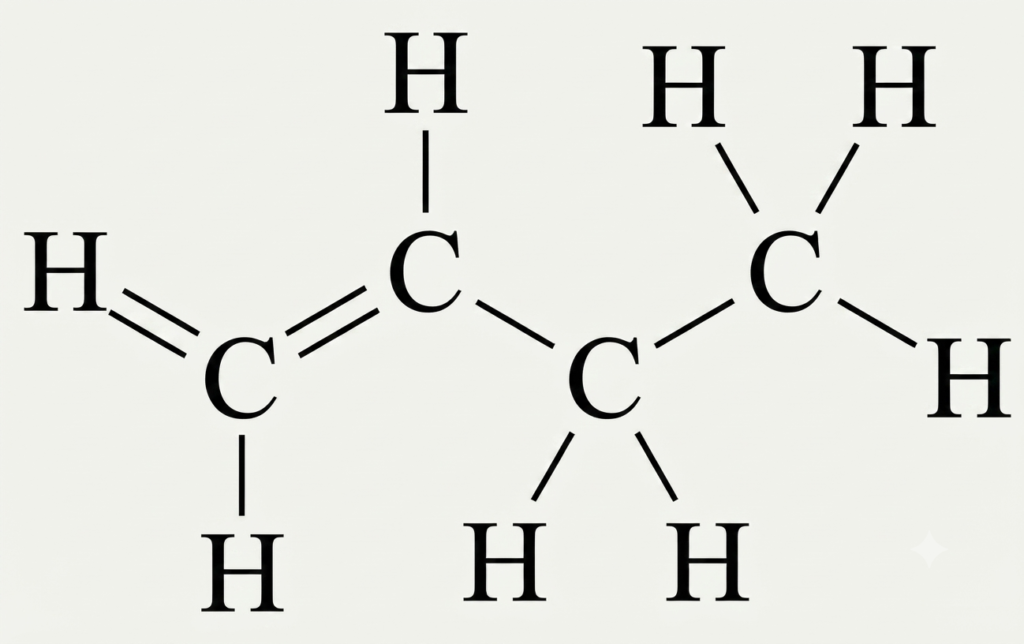
The structural formula of 1-butene is:
CH₂=CH–CH₂–CH₃
The structural formula of 2-butene is:
CH₃–CH=CH–CH₃
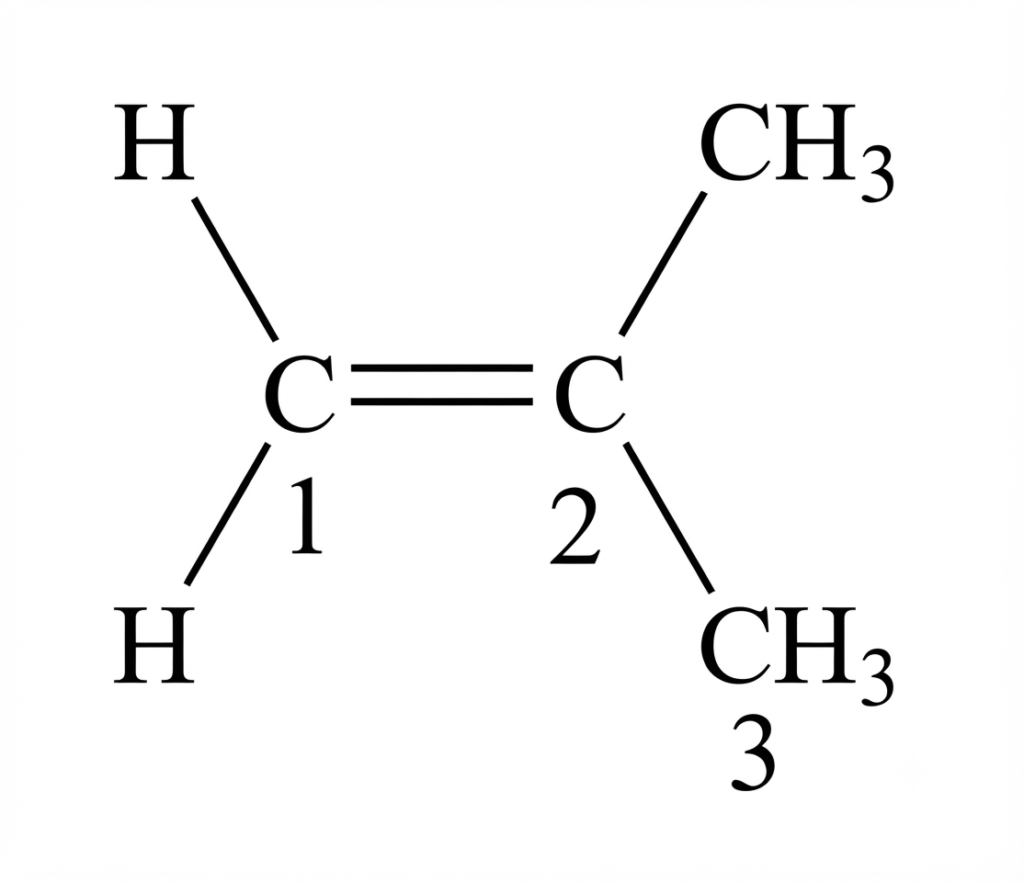
Although both molecules contain four carbon atoms and one double bond, shifting the position of the double bond changes their molecular geometry and chemical behavior.
3. Position of the Double Bond
The location of the double bond is the defining feature that distinguishes these two alkenes.
In 1-butene, the double bond occurs at the end of the carbon chain between carbon atoms C1 and C2. Because it is terminal, the compound belongs to the alpha-olefin family and readily undergoes addition and polymerization reactions.
In 2-butene, the double bond is positioned between C2 and C3, placing it in the center of the molecule. This internal arrangement makes the molecule more symmetrical and generally more stable than its terminal counterpart.
4. Type of Isomer
Both compounds are constitutional (structural) isomers because they have the same molecular formula but different atomic arrangements.
1-Butene is classified as a terminal alkene, whereas 2-butene is classified as an internal alkene. In addition, 2-butene exhibits geometrical (cis-trans) isomerism, while 1-butene does not because one carbon atom of its double bond carries two identical hydrogen atoms.
5. Molecular Geometry
The position of the double bond also influences the three-dimensional arrangement of atoms.
1-Butene has a less symmetrical molecular structure due to its terminal double bond. This asymmetry contributes to its higher chemical reactivity.
2-Butene has a more symmetrical arrangement around the double bond and can exist as cis and trans isomers. The trans form is generally more stable because the larger methyl groups are positioned on opposite sides of the double bond, reducing steric repulsion.
6. Physical Properties
Although 1-butene and 2-butene have the same molecular formula (C₄H₈), their physical properties are not identical. The position of the double bond influences characteristics such as boiling point, melting point, molecular symmetry, and intermolecular forces. These differences are important when selecting a compound for industrial or laboratory applications.
Physical Properties of 1-Butene
- Colorless gas at room temperature
- Molecular formula: C₄H₈
- Molar mass: 56.11 g/mol
- Terminal double bond
- Boiling point of approximately -6.3°C (-21.3°F), Slightly lower boiling point than 2-butene
- Highly flammable
- Slight hydrocarbon-like odor
- Easily liquefied under pressure
Physical Properties of 2-Butene
- Colorless gas under normal conditions
- Molecular formula: C₄H₈
- Molar mass: 56.11 g/mol
- Internal double bond
- Boiling point of around -4.9°C (23.2°F).
- Exists as cis and trans isomers
- Slightly higher boiling point due to its molecular arrangement
- Highly flammable
- Characteristic hydrocarbon odor
Although these differences may appear small, they influence storage, transportation, separation processes, and industrial applications.
7. Stability
One of the most important differences between these two alkenes is their chemical stability.
1-Butene is generally less thermodynamically stable because its double bond is located at the end of the carbon chain. Terminal alkenes possess fewer alkyl groups attached to the double-bonded carbon atoms, providing less electron donation through hyperconjugation. As a result, they contain slightly higher energy and are more reactive.
2-Butene, on the other hand, is more stable because its double bond is positioned in the middle of the carbon chain. The additional alkyl groups surrounding the double bond stabilize the molecule through hyperconjugation and inductive effects. Among its stereoisomers, trans-2-butene is more stable than cis-2-butene because the methyl groups are farther apart, minimizing steric hindrance.
Greater stability makes 2-butene the preferred compound for several industrial reactions where controlled reactivity is desirable.
8. Reactivity
The location of the double bond also influences how these compounds participate in chemical reactions.
1-Butene is generally more reactive because the terminal double bond is more accessible to reacting molecules. It readily undergoes addition reactions such as hydrogenation, halogenation, hydration, and polymerization. This higher reactivity makes it an excellent raw material for manufacturing polyethylene and other polymers.
2-Butene is comparatively less reactive because its internal double bond is more substituted and therefore more stable. However, it still participates in typical alkene reactions, including catalytic hydrogenation, oxidation, and halogen addition. It is especially valuable in producing butadiene, methyl ethyl ketone (MEK), and other petrochemical intermediates.
In simple terms:
- 1-Butene reacts more easily because of its terminal double bond.
- 2-Butene reacts more selectively because its internal double bond is more stable.
9. Geometrical Isomerism
Geometrical isomerism is another major distinction between 1-Butene vs. 2-Butene
1-Butene does not exhibit cis-trans isomerism because one carbon atom involved in the double bond is attached to two identical hydrogen atoms. Since each carbon of the double bond must have two different substituents for geometrical isomerism to occur, 1-butene cannot exist as cis or trans forms.
2-Butene, however, exists in two geometrical isomers:
Cis-2-Butene
In the cis isomer, both methyl (–CH₃) groups are located on the same side of the carbon-carbon double bond. This arrangement creates greater steric repulsion, making cis-2-butene slightly less stable.
Trans-2-Butene
In the trans isomer, the methyl groups lie on opposite sides of the double bond. This arrangement minimizes steric hindrance, resulting in greater stability and lower molecular energy.
The presence of cis-trans isomerism gives 2-butene unique physical and chemical properties that are absent in 1-butene.
10. Industrial Production
Both compounds are produced commercially from petroleum feedstocks, but their manufacturing methods and purification processes differ slightly.
Production of 1-Butene
1-Butene is mainly obtained through:
- Steam cracking of hydrocarbons
- Catalytic cracking in petroleum refineries
- Ethylene dimerization
- Separation from mixed C₄ hydrocarbon streams
After production, purification is carried out using fractional distillation and selective separation techniques to obtain high-purity 1-butene for polymer manufacturing.
Production of 2-Butene
2-Butene is commonly produced by:
- Catalytic cracking of crude oil fractions
- Isomerization of 1-butene
- Separation from refinery C₄ streams
Commercial production usually yields a mixture of cis-2-butene and trans-2-butene, which are often used together because many industrial processes do not require separation of the two stereoisomers.
11. Industrial Uses
Although both compounds belong to the alkene family, their industrial applications differ because of their structural differences.
Uses of 1-Butene
1-Butene is widely used as an important petrochemical feedstock for manufacturing various commercial products.
Its major applications include:
- Production of Linear Low-Density Polyethylene (LLDPE)
- Manufacturing High-Density Polyethylene (HDPE)
- Production of synthetic lubricants
- Manufacturing plastic additives
- Chemical intermediate for specialty chemicals
- Fuel additives
- Production of alpha-olefin-based products
Uses of 2-Butene
2-Butene is primarily used in the manufacture of industrial chemicals rather than polymers.
Its major applications include:
- Production of butadiene for synthetic rubber
- Manufacturing methyl ethyl ketone (MEK)
- Gasoline blending
- Production of industrial solvents
- Intermediate for pharmaceuticals
- Fragrance and specialty chemical synthesis
- Organic chemical manufacturing
The difference in applications highlights how a simple shift in the position of a double bond can significantly influence the commercial value and industrial use of an organic compound.
Similarities Between 1-Butene and 2-Butene
Despite having different structures, 1-butene and 2-butene share several important characteristics because both belong to the alkene family. Their common molecular formula and similar chemical composition give them many comparable physical and chemical properties.
Some of the major similarities include:
- Both have the same molecular formula, C₄H₈.
- Both are alkenes containing one carbon-carbon double bond.
- Both are unsaturated hydrocarbons.
- Both are structural isomers of butene.
- Both are colorless gases at room temperature.
- Both are highly flammable.
- Both undergo addition reactions such as hydrogenation, halogenation, and hydration.
- Both are produced from petroleum refining and steam cracking processes.
- Both serve as valuable raw materials in the petrochemical industry.
- Both are important intermediates for manufacturing plastics, fuels, and industrial chemicals.
Advantages and Uses of 1-Butene
1-Butene is one of the most valuable alpha-olefins used in the petrochemical industry. Its terminal double bond makes it highly reactive, allowing it to participate efficiently in polymerization and other industrial chemical reactions.
The major advantages and uses of 1-butene include:
- Excellent monomer for polyethylene production, particularly Linear Low-Density Polyethylene (LLDPE).
- Higher chemical reactivity due to its terminal double bond.
- Widely used in polymer manufacturing for producing durable plastic products.
- Important feedstock for alpha-olefin production.
- Used in synthetic lubricant manufacturing.
- Acts as an intermediate for various industrial chemicals.
- Improves fuel quality when used as a gasoline blending component.
- Easy to separate and purify from refinery streams.
- Supports large-scale petrochemical production worldwide.
- Essential raw material for plastic packaging, pipes, films, and molded products.
Advantages and Uses of 2-Butene
2-Butene plays a crucial role in producing industrial chemicals and synthetic materials. Its greater stability and ability to exist as cis and trans isomers make it suitable for several controlled chemical processes.
The major advantages and uses of 2-butene include:
- Greater thermodynamic stability than 1-butene.
- Available as cis and trans isomers, providing versatility in chemical synthesis.
- Major raw material for butadiene production, which is essential for synthetic rubber.
- Used in manufacturing methyl ethyl ketone (MEK) and other industrial solvents.
- Useful in gasoline blending to improve fuel quality.
- Serves as an intermediate in the synthesis of pharmaceuticals and specialty chemicals.
- Participates efficiently in catalytic reactions because of its internal double bond.
- Suitable for large-scale petrochemical processes requiring stable alkene feedstocks.
- Supports the production of adhesives, coatings, and resins.
- Widely used in organic synthesis across the chemical industry.
Safety and Handling
Both 1-butene and 2-butene are highly flammable hydrocarbons and should be handled with appropriate safety precautions. Since they are gases under normal atmospheric conditions, they are typically stored and transported as liquefied gases under pressure.
When working with these compounds, follow these safety guidelines:
- Keep away from heat, sparks, flames, and other ignition sources.
- Store in tightly sealed, approved pressure containers.
- Use adequate ventilation to prevent vapor accumulation.
- Wear appropriate personal protective equipment (PPE), including gloves and safety goggles.
- Avoid inhalation of high vapor concentrations, as they may cause dizziness, headache, or respiratory irritation.
- Prevent leaks in enclosed areas because flammable gas-air mixtures can ignite easily.
- Follow local environmental and industrial regulations for storage, transportation, and disposal.
Which Is More Important?
Neither 1-butene nor 2-butene is universally more important because each serves a different purpose in the chemical industry.
1-Butene is preferred for polymer manufacturing because its terminal double bond makes it highly reactive during polymerization. It is an essential raw material for producing polyethylene, one of the world’s most widely used plastics.
2-Butene, in contrast, is valued for its greater stability and its role in producing butadiene, solvents, synthetic rubber, and numerous industrial chemicals. Its cis-trans isomerism also provides additional flexibility in organic synthesis.
In practice, the choice between the two depends entirely on the intended industrial application rather than one compound being inherently superior to the other.
Conclusion
The comparison of 1-Butene vs. 2-Butene shows that although both compounds have the same molecular formula (C₄H₈), they differ significantly in the position of their double bond, molecular structure, stability, reactivity, and industrial applications.
1-Butene is a terminal alkene with a highly reactive double bond, making it ideal for polymer production, while 2-butene is an internal alkene that offers greater stability and exists as cis and trans isomers.
These structural differences influence how each compound behaves in chemical reactions and determine its suitability for manufacturing plastics, synthetic rubber, fuels, solvents, and other petrochemical products. Understanding these distinctions helps students and industry professionals choose the appropriate compound for specific chemical processes and applications.
Frequently Asked Questions (FAQs)
No. Both compounds have the same molecular formula (C₄H₈) but differ in the position of the carbon-carbon double bond.
2-Butene is more thermodynamically stable because its double bond is located in the middle of the carbon chain, making it more substituted.
The internal double bond in 2-butene allows two different spatial arrangements of the methyl groups, resulting in cis and trans geometric isomers.
One carbon atom of the double bond in 1-butene is attached to two hydrogen atoms, so it does not satisfy the conditions required for cis-trans isomerism.
1-Butene is generally more reactive because its terminal double bond is more accessible for addition and polymerization reactions.
It is mainly used for producing Linear Low-Density Polyethylene (LLDPE), High-Density Polyethylene (HDPE), synthetic lubricants, and specialty chemicals.
It is commonly used in the production of butadiene, methyl ethyl ketone (MEK), industrial solvents, gasoline blending components, and synthetic rubber.
Reference:
1. “2-Butene.” National Center for Biotechnology Information. PubChem Compound Database, U.S. National Library of Medicine.
Read Next:
- Phosphodiester Bond vs. Phosphoester Bond
- Difference Between Methyl and Methylene Group (CH3 vs CH2)
- Difference Between Isosmotic Hyperosmotic and Hypoosmotic
- Difference Between Phosphorylase and Phosphatase
- Difference Between Molecular Equation and Ionic Equation
- Chloride vs. Chlorite: What’s the Difference?
- Olefins vs. Paraffins: What’s the Difference?
- Olefin vs. Polypropylene: What’s the Difference?
- Cetyl Alcohol vs. Stearyl Alcohol: What’s the Difference?
- Buchner Funnel vs. Hirsch Funnel
- Polycarbonate vs. Polyurethane
- Hydrogen Peroxide vs. Peroxide