The main difference between Cetyl Alcohol vs. Stearyl Alcohol is that cetyl alcohol is a fatty alcohol with 16 carbon atoms (C₁₆H₃₄O), whereas stearyl alcohol contains 18 carbon atoms (C₁₈H₃₈O). Due to its shorter carbon chain, cetyl alcohol has a lower melting point and a softer texture, making it ideal for lightweight creams, lotions, and hair conditioners. Stearyl alcohol, with its longer carbon chain, has a higher melting point and provides greater thickness and stability, making it suitable for richer creams, ointments, lip balms, and solid cosmetic products.
Understanding the difference between Cetyl Alcohol vs. Stearyl Alcohol is important for cosmetic formulators, skincare enthusiasts, pharmacists, chemical engineers, manufacturers, and students because these two fatty alcohols differ in their chemical structure, physical properties, thickening ability, emulsifying performance, industrial applications, and formulation characteristics.
Cetyl Alcohol vs. Stearyl Alcohol Comparison Table
The table below highlights the major differences between Cetyl Alcohol vs. Stearyl Alcohol.
| Feature | Cetyl Alcohol | Stearyl Alcohol |
| Chemical Name | 1-Hexadecanol | 1-Octadecanol |
| Molecular Formula | C₁₆H₃₄O | C₁₈H₃₈O |
| Carbon Atoms | 16 | 18 |
| Molecular Weight | 242.44 g/mol | 270.49 g/mol |
| Chemical Family | Fatty alcohol | Fatty alcohol |
| Appearance | White waxy solid | White waxy solid |
| Texture | Softer | Harder |
| Melting Point | About 49–52°C | About 58–60°C |
| Solubility | Insoluble in water; soluble in oils and alcohol | Insoluble in water; soluble in oils and alcohol |
| Thickening Ability | Moderate | High |
| Emulsifying Ability | Excellent | Excellent |
| Moisturizing Effect | Excellent | Excellent |
| Skin Feel | Light and smooth | Rich and creamy |
| Common Uses | Lotions, creams, conditioners | Creams, ointments, lip balms, soaps |
| Cosmetic Stability | Good | Excellent |
| Industrial Applications | Cosmetics, pharmaceuticals | Cosmetics, pharmaceuticals, candles |
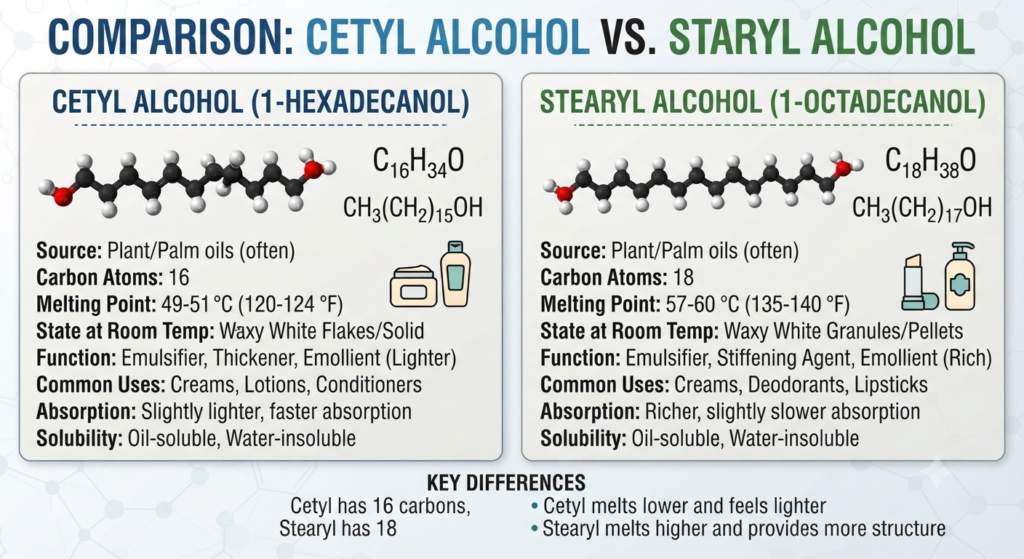
What Is Cetyl Alcohol?
Cetyl alcohol is a long-chain fatty alcohol consisting of 16 carbon atoms. Despite the name “alcohol,” it is very different from ethanol or isopropyl alcohol because it is non-drying, non-irritating, and non-intoxicating.
It is usually derived from vegetable oils such as coconut oil and palm oil or produced synthetically. Cetyl alcohol functions as an emollient, emulsifier, thickener, and stabilizer in cosmetic and pharmaceutical formulations.
It helps improve the texture of skincare products, prevents moisture loss, and gives creams and lotions a smooth, luxurious feel.
Common Applications
- Moisturizers
- Face creams
- Body lotions
- Hair conditioners
- Sunscreens
- Pharmaceutical creams
Key Characteristics of Cetyl Alcohol
- Fatty alcohol with 16 carbon atoms
- Molecular formula: C₁₆H₃₄O
- White waxy solid
- Lower melting point
- Soft texture
- Excellent emollient
- Effective thickening agent
- Good emulsifier
- Improves product spreadability
- Commonly used in cosmetic formulations
What Is Stearyl Alcohol?
Stearyl alcohol is another long-chain fatty alcohol, but it contains 18 carbon atoms, making it slightly heavier and harder than cetyl alcohol.
Like cetyl alcohol, it is obtained from vegetable oils or manufactured synthetically. Stearyl alcohol is widely used as a thickener, emulsifier, emollient, and stabilizer in cosmetics, pharmaceuticals, and industrial products.
Because of its higher melting point and firmer consistency, stearyl alcohol provides additional body, stability, and richness to creams, ointments, and other semi-solid formulations.
Common Applications
- Skin creams
- Ointments
- Lip balms
- Hair care products
- Soaps
- Candles
Key Characteristics of Stearyl Alcohol
- Fatty alcohol with 18 carbon atoms
- Molecular formula: C₁₈H₃₈O
- White waxy solid
- Higher melting point
- Harder texture
- Excellent thickener
- Effective emulsifier
- Improves formulation stability
- Provides rich consistency
- Widely used in cosmetics and pharmaceuticals
Cetyl Alcohol vs. Stearyl Alcohol: Key Differences
1. Definition
Although both cetyl alcohol and stearyl alcohol belong to the fatty alcohol family, they differ primarily in the length of their carbon chains.
Cetyl alcohol is a fatty alcohol containing 16 carbon atoms, making it softer and easier to incorporate into lightweight cosmetic formulations.
Stearyl alcohol is a fatty alcohol containing 18 carbon atoms, giving it a firmer texture and better thickening properties.
This small structural difference significantly affects their physical properties and applications.
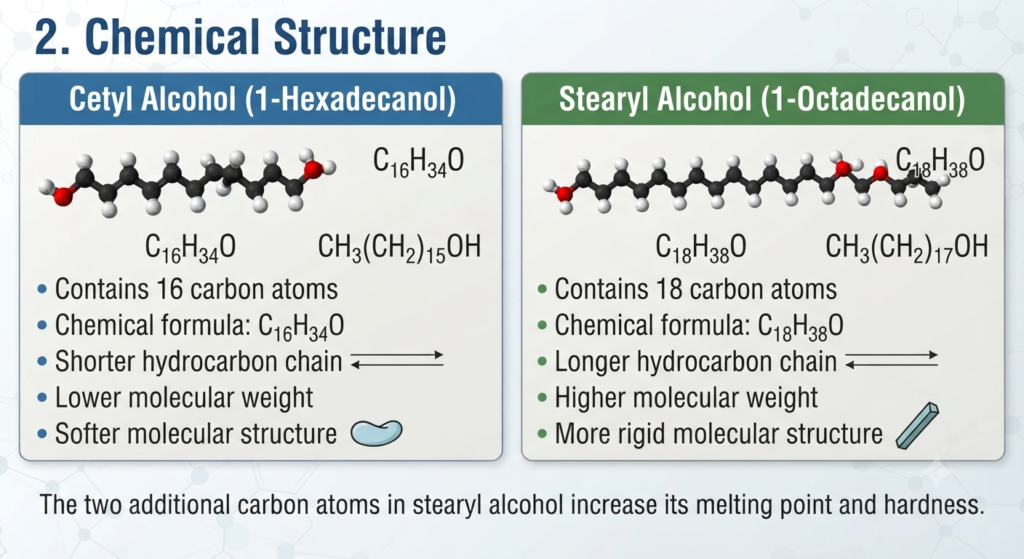
2. Chemical Structure
The most important distinction in Cetyl Alcohol vs. Stearyl Alcohol is their molecular structure.
Cetyl Alcohol
Characteristics include:
- Contains 16 carbon atoms
- Chemical formula: C₁₆H₃₄O
- Shorter hydrocarbon chain
- Lower molecular weight
- Softer molecular structure
Stearyl Alcohol
Characteristics include:
- Contains 18 carbon atoms
- Chemical formula: C₁₈H₃₈O
- Longer hydrocarbon chain
- Higher molecular weight
- More rigid molecular structure
The two additional carbon atoms in stearyl alcohol increase its melting point and hardness.
3. Molecular Weight
Another major difference is molecular weight.
Cetyl Alcohol
Cetyl alcohol has a molecular weight of approximately 242.44 g/mol, making it lighter and easier to blend into emulsions.
Characteristics include:
- Molecular weight: 242.44 g/mol
- Lower density compared to stearyl alcohol
- Suitable for lighter formulations
Stearyl Alcohol
Stearyl alcohol has a molecular weight of approximately 270.49 g/mol, contributing to its thicker consistency and stronger structural properties.
Characteristics include:
- Molecular weight: 270.49 g/mol
- Higher molecular weight
- Better thickening performance
- Produces richer formulations
4. Carbon Chain Length
The carbon chain length strongly influences the behavior of fatty alcohols.
Cetyl Alcohol
Characteristics include:
- 16-carbon chain
- Shorter hydrocarbon backbone
- Softer consistency
- Lower melting point
- Better spreadability
Stearyl Alcohol
Characteristics include:
- 18-carbon chain
- Longer hydrocarbon backbone
- Firmer consistency
- Higher melting point
- Increased viscosity
Even this small difference of two carbon atoms has a noticeable impact on cosmetic formulation performance.
5. Physical Properties
Although both fatty alcohols appear similar, their physical properties differ due to their molecular structures.
Cetyl Alcohol
Physical characteristics include:
- White waxy solid
- Softer texture
- Melting point around 49–52°C
- Smooth, lightweight feel
- Insoluble in water
- Soluble in oils and alcohol
- Easier to spread on the skin
Stearyl Alcohol
Physical characteristics include:
- White waxy solid
- Harder texture
- Melting point around 58–60°C
- Rich, creamy feel
- Insoluble in water
- Soluble in oils and alcohol
- Provides greater structural stability
Because of its higher melting point and firmer consistency, stearyl alcohol is often selected for formulations requiring additional thickness and stability.
6. Thickening Ability
One of the most significant formulation differences between Cetyl Alcohol vs. Stearyl Alcohol is their thickening ability. Although both are effective thickening agents, stearyl alcohol generally produces thicker and more stable formulations because of its longer carbon chain.
Cetyl Alcohol
Cetyl alcohol provides moderate thickening while maintaining a smooth, lightweight texture. It improves the consistency of lotions and creams without making them feel overly heavy.
Characteristics include:
- Moderate thickening ability
- Produces smooth, lightweight formulations
- Improves cream consistency
- Easy to spread on the skin
- Suitable for lotions and hair conditioners
Stearyl Alcohol
Stearyl alcohol provides stronger thickening and increases the viscosity of cosmetic formulations. It gives creams and ointments a richer, denser texture.
Characteristics include:
- High thickening ability
- Produces richer formulations
- Increases viscosity
- Improves structural stability
- Ideal for heavy creams and ointments
7. Melting Point
The melting point is another major difference between Cetyl Alcohol vs. Stearyl Alcohol. It affects product stability, manufacturing conditions, and the final texture of cosmetic products.
Cetyl Alcohol
Cetyl alcohol melts at a relatively lower temperature, making it suitable for products that require a softer consistency.
Characteristics include:
- Melting point of approximately 49–52°C
- Softens more easily during manufacturing
- Produces lighter formulations
- Suitable for creams and lotions
Stearyl Alcohol
Stearyl alcohol has a higher melting point because of its longer hydrocarbon chain, allowing products to remain firmer under warm conditions.
Characteristics include:
- Melting point of approximately 58–60°C
- Better heat resistance
- Produces firmer products
- Suitable for solid and semi-solid formulations
8. Emulsifying Ability
Both fatty alcohols act as co-emulsifiers that help stabilize oil-in-water and water-in-oil emulsions. However, their performance varies slightly depending on the formulation.
Cetyl Alcohol
Cetyl alcohol helps create stable emulsions while giving products a silky and lightweight feel.
Characteristics include:
- Excellent co-emulsifier
- Stabilizes emulsions
- Improves spreadability
- Produces a smooth texture
- Suitable for lightweight skincare products
Stearyl Alcohol
Stearyl alcohol also functions as an excellent emulsifier but contributes more body and stability to the finished product.
Characteristics include:
- Excellent co-emulsifier
- Enhances emulsion stability
- Produces thicker creams
- Improves product consistency
- Suitable for richer formulations
9. Moisturizing Properties
Both cetyl alcohol and stearyl alcohol are widely used as emollients that help soften the skin and reduce moisture loss.
Cetyl Alcohol
Cetyl alcohol forms a protective barrier on the skin that helps retain moisture without leaving a heavy or greasy feeling.
Characteristics include:
- Excellent emollient
- Softens the skin
- Reduces water loss
- Provides a smooth finish
- Lightweight moisturizing effect
Stearyl Alcohol
Stearyl alcohol also moisturizes the skin effectively but creates a richer and more protective barrier, making it suitable for dry skin formulations.
Characteristics include:
- Excellent emollient
- Provides long-lasting hydration
- Strengthens the skin barrier
- Rich moisturizing effect
- Ideal for dry and sensitive skin products
10. Cosmetic Applications
Although both fatty alcohols are extensively used in personal care products, their preferred applications differ because of their physical properties.
Cetyl Alcohol
Cetyl alcohol is commonly selected for products that require a lighter texture and excellent spreadability.
Major applications include:
- Facial moisturizers
- Body lotions
- Hair conditioners
- Sunscreens
- Cleansing creams
- Facial serums
- Leave-in hair products
Stearyl Alcohol
Stearyl alcohol is preferred for products that require greater thickness, stability, and a richer texture.
Major applications include:
- Rich moisturizing creams
- Ointments
- Lip balms
- Body butters
- Hair masks
- Bar soaps
- Pharmaceutical creams
The choice between cetyl alcohol and stearyl alcohol depends on the desired texture, viscosity, stability, and performance of the final cosmetic or pharmaceutical formulation.
11. Pharmaceutical Applications
Both fatty alcohols are widely used in the pharmaceutical industry as inactive ingredients (excipients). They improve the consistency, stability, and performance of topical medicines.
Cetyl Alcohol
Cetyl alcohol is commonly used in formulations that require a smooth texture and easy application.
Major pharmaceutical applications include:
- Skin creams
- Moisturizing ointments
- Topical lotions
- Medicated emulsions
- Dermatological preparations
- Cosmetic pharmaceuticals
Stearyl Alcohol
Stearyl alcohol is preferred for products requiring greater firmness and long-lasting stability.
Major pharmaceutical applications include:
- Medicated ointments
- Barrier creams
- Topical drug formulations
- Antifungal creams
- Anti-inflammatory creams
- Protective skin preparations
Both alcohols are considered safe pharmaceutical excipients and help improve the texture and shelf life of topical medications.
12. Industrial Applications
Beyond cosmetics and pharmaceuticals, both cetyl alcohol and stearyl alcohol are used in several industrial processes.
Cetyl Alcohol
Common industrial applications include:
- Cosmetic manufacturing
- Personal care products
- Lubricants
- Textile processing
- Emulsifiers
- Surfactant production
- Industrial cleaners
Stearyl Alcohol
Common industrial applications include:
- Candle manufacturing
- Polishes
- Lubricants
- Textile chemicals
- Plastic additives
- Coatings
- Industrial emulsifiers
Their excellent thickening, lubricating, and stabilizing properties make both fatty alcohols valuable industrial raw materials.
13. Stability and Shelf Life
Stability is another important factor when comparing Cetyl Alcohol vs. Stearyl Alcohol.
Cetyl Alcohol
Cetyl alcohol offers good chemical stability under normal storage conditions.
Characteristics include:
- Resistant to oxidation
- Stable in cosmetic formulations
- Long shelf life
- Performs well over a wide pH range
Stearyl Alcohol
Stearyl alcohol generally provides even greater formulation stability because of its higher melting point.
Characteristics include:
- Highly stable
- Excellent heat resistance
- Improves product shelf life
- Maintains formulation consistency during storage
Both ingredients are chemically stable and help extend the shelf life of creams, lotions, and ointments.
14. Safety and Skin Compatibility
Both cetyl alcohol and stearyl alcohol are regarded as safe ingredients for cosmetic and pharmaceutical use when used within recommended concentrations.
Cetyl Alcohol
Safety characteristics include:
- Generally non-irritating
- Suitable for sensitive skin
- Low risk of allergic reactions
- Non-toxic
- Non-drying
Stearyl Alcohol
Safety characteristics include:
- Generally well tolerated
- Low skin irritation potential
- Suitable for most skin types
- Non-toxic
- Safe for regular cosmetic use
Unlike simple alcohols such as ethanol or isopropyl alcohol, these fatty alcohols do not dry out the skin. Instead, they help improve skin hydration and softness.
Similarities Between Cetyl Alcohol and Stearyl Alcohol
Although Cetyl Alcohol vs. Stearyl Alcohol have several differences, they also share many important characteristics.
Some major similarities include:
- Both are fatty alcohols.
- Both are white, waxy solids at room temperature.
- Both are derived from natural oils or produced synthetically.
- Both are insoluble in water.
- Both act as emollients and skin-conditioning agents.
- Both function as thickening agents.
- Both improve emulsion stability.
- Both are widely used in cosmetics and pharmaceuticals.
- Both enhance the texture of creams and lotions.
- Both are considered safe for topical use.
Their shared properties make them valuable ingredients in thousands of personal care and pharmaceutical products worldwide.
Advantages and Uses of Cetyl Alcohol
Cetyl alcohol is widely used because it provides excellent conditioning and a lightweight feel in cosmetic formulations.
Major advantages and uses include:
- Excellent skin conditioner
- Softens and smooths the skin
- Lightweight moisturizing effect
- Improves product spreadability
- Stabilizes emulsions
- Thickens lotions and creams
- Enhances hair conditioning products
- Reduces moisture loss
- Improves cosmetic texture
- Widely used in facial creams, lotions, shampoos, and conditioners
Its silky texture makes it one of the most popular fatty alcohols in skincare and haircare products.
Advantages and Uses of Stearyl Alcohol
Stearyl alcohol is valued for its superior thickening ability and rich moisturizing properties.
Major advantages and uses include:
- Powerful thickening agent
- Produces rich, luxurious creams
- Long-lasting moisturizing effect
- Improves formulation stability
- Enhances product viscosity
- Strengthens emulsions
- Used in ointments and body butters
- Suitable for lip balms and soaps
- Improves shelf life
- Provides excellent skin protection
Its higher melting point and richer consistency make it ideal for products designed for dry skin and heavy-duty moisturizing.
Safety and Handling
Both cetyl alcohol and stearyl alcohol are considered safe ingredients in cosmetic, pharmaceutical, and personal care products. Unlike simple alcohols such as ethanol or isopropyl alcohol, these fatty alcohols are non-drying and are commonly used to moisturize and protect the skin.
When handling these ingredients in manufacturing or laboratory environments, follow these general safety practices:
- Store in tightly sealed containers.
- Keep in a cool, dry, and well-ventilated area.
- Protect from excessive heat and moisture.
- Avoid generating excessive dust during handling.
- Wear appropriate personal protective equipment (PPE), including gloves and safety glasses.
- Wash thoroughly after handling.
- Follow local safety and environmental regulations.
- Dispose of waste according to applicable guidelines.
Additional Precautions for Cetyl Alcohol
- Melt slowly using controlled heating.
- Avoid prolonged exposure to high temperatures.
- Prevent contamination with strong oxidizing agents.
- Store away from direct sunlight to maintain product quality.
Additional Precautions for Stearyl Alcohol
- Heat gradually to avoid product degradation.
- Keep containers tightly closed after use.
- Avoid contamination with incompatible chemicals.
- Clean spills promptly, as melted material may create slip hazards.
Proper storage and handling help maintain product quality and ensure safe manufacturing practices.
Which Is Better—Cetyl Alcohol or Stearyl Alcohol?
Neither cetyl alcohol nor stearyl alcohol is universally better because each serves a different purpose in cosmetic and pharmaceutical formulations.
Cetyl alcohol is the better choice when a lightweight texture, silky feel, and easy spreadability are desired. It is widely used in facial creams, lotions, hair conditioners, and products designed for normal to oily skin.
Stearyl alcohol, on the other hand, is preferred when greater viscosity, richer texture, and improved stability are required. It is commonly used in body butters, ointments, lip balms, and products formulated for dry or damaged skin.
Many manufacturers combine both ingredients as cetearyl alcohol to achieve an ideal balance of softness, thickness, stability, and moisturizing performance.
Conclusion
The comparison of Cetyl Alcohol vs. Stearyl Alcohol shows that although both are fatty alcohols with similar functions, they differ in carbon chain length, melting point, texture, thickening ability, and formulation performance. Cetyl alcohol contains 16 carbon atoms, giving it a softer texture and lighter feel, while stearyl alcohol contains 18 carbon atoms, making it harder, thicker, and more suitable for rich formulations.
Both ingredients are excellent emollients, emulsifiers, and viscosity modifiers that improve the texture, stability, and moisturizing properties of cosmetic and pharmaceutical products. Understanding the differences between Cetyl Alcohol vs. Stearyl Alcohol helps cosmetic chemists, skincare manufacturers, pharmacists, formulators, and consumers choose the most suitable ingredient for a specific application.
Frequently Asked Questions (FAQs)
The main difference between Cetyl Alcohol vs. Stearyl Alcohol is that cetyl alcohol contains 16 carbon atoms (C₁₆H₃₄O) and provides a softer, lighter texture, whereas stearyl alcohol contains 18 carbon atoms (C₁₈H₃₈O) and produces thicker, richer, and more stable formulations.
Yes. Cetyl alcohol is considered safe for cosmetic and pharmaceutical use. It is a fatty alcohol that moisturizes and softens the skin rather than drying it.
No. Stearyl alcohol is a fatty alcohol used as an emollient and thickening agent, whereas rubbing alcohol usually refers to isopropyl alcohol, which evaporates quickly and can dry the skin.
Cetearyl alcohol is a mixture of cetyl alcohol and stearyl alcohol. It combines the lightweight conditioning properties of cetyl alcohol with the superior thickening ability of stearyl alcohol, making it one of the most widely used fatty alcohols in cosmetics.
Stearyl alcohol is generally preferred for very dry skin because it provides a richer texture, stronger moisture barrier, and better long-lasting hydration. Cetyl alcohol is often chosen for lighter moisturizers suitable for normal or combination skin.
Reference:
1. “Stearyl Alcohol.” Wikipedia, Wikimedia Foundation, 25 Aug. 2019
2. “Cetyl Alcohol.” Wikipedia, Wikimedia Foundation, 19 Sept. 2019
Read Next: