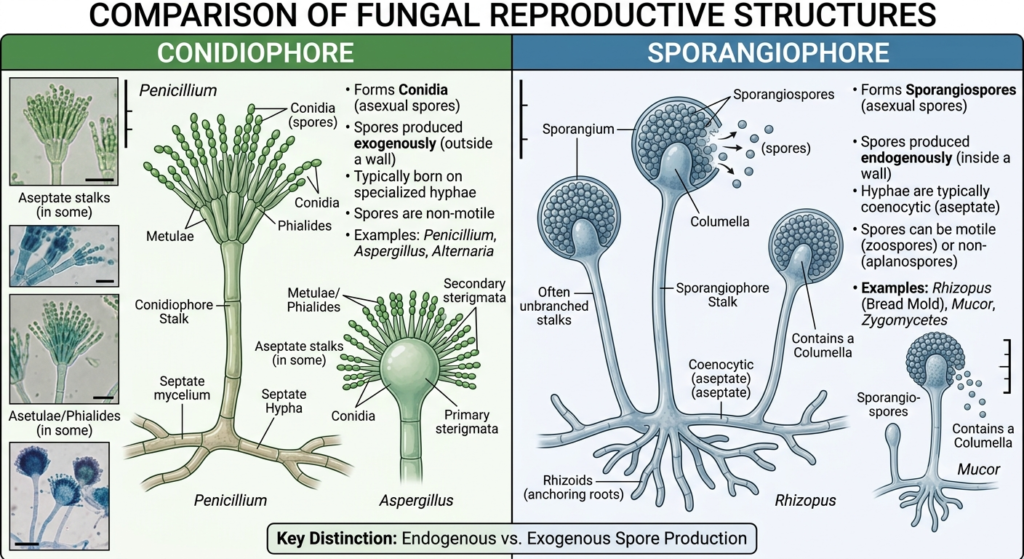
The main difference between Conidiophore vs. Sporangiophore is the type of reproductive structure and spores they produce. A conidiophore is a specialized fungal hypha that produces conidia, which are usually asexual spores formed externally without being enclosed in a sac. A sporangiophore is a specialized hypha that bears a sporangium, a sac-like structure in which spores develop. Both structures help fungi reproduce and spread, but they differ in their structure, method of spore formation, and the fungal groups in which they occur.
Understanding Conidiophore vs. Sporangiophore is important in mycology because these structures are useful for identifying fungi and understanding their asexual reproductive cycles. Conidiophores are characteristic of fungi that produce conidia, while sporangiophores are associated with fungi that produce sporangia.
Conidiophore vs. Sporangiophore Comparison Table
The table below highlights the major differences between Conidiophore vs. Sporangiophore.
| Feature | Conidiophore | Sporangiophore |
| Definition | Specialized hypha that produces conidia | Specialized hypha that bears a sporangium |
| Main Reproductive Structure | Conidia | Sporangium |
| Type of Spore | Conidia | Sporangiospores |
| Spore Location | Usually produced externally | Produced inside a sporangium |
| Spore Enclosure | Spores are generally not enclosed in a sac | Spores are enclosed within the sporangium |
| Spore Release | Conidia are usually released individually or in chains | Spores are released after the sporangium opens or breaks down |
| Typical Examples | Aspergillus and Penicillium | Rhizopus and Mucor |
| Structure | May be simple or highly branched | Usually consists of a stalk ending in a sporangium |
| Primary Function | Production and dispersal of conidia | Production and dispersal of sporangiospores |
| Commonly Associated Fungi | Many Ascomycota and related fungi | Mainly certain early-diverging fungal groups |
| Visibility | Often visible as specialized spore-bearing structures | Often recognizable by the terminal sporangium |
| Role in Asexual Reproduction | Produces asexual conidia | Produces asexual spores within a sporangium |
What Is a Conidiophore?
A conidiophore is a specialized fungal hypha that produces and supports conidia. Conidia are asexual spores that are generally formed externally rather than inside a closed spore case.
Conidiophores are found in many fungi, particularly members of Ascomycota and some related groups. Familiar examples include Aspergillus and Penicillium.
The shape and organization of a conidiophore vary considerably between fungal species. Some are simple and unbranched, while others have elaborate branching patterns and specialized cells that produce conidia.
Conidia may occur singly, in chains, or in clusters. Because they are often lightweight, they can be dispersed effectively by air currents, animals, water, or physical contact.
Characteristics of Conidiophores
Important characteristics of conidiophores include:
- They are specialized fungal hyphae.
- They are involved mainly in asexual reproduction.
- They produce conidia.
- Conidia are generally formed externally.
- They may be simple or branched.
- Their structure varies between fungal species.
- They can support specialized conidium-producing cells.
- Conidia may occur singly, in chains, or in clusters.
- They can promote rapid fungal dispersal.
- They are important features in fungal identification.
Examples of Conidiophores
Examples of fungi that produce conidiophores include:
- Aspergillus species.
- Penicillium species.
- Alternaria species.
- Cladosporium species.
- Many other conidium-producing fungi.
The detailed structure of the conidiophore differs among species and is often useful in microscopic identification.
What Is a Sporangiophore?
A sporangiophore is a specialized fungal hypha that bears a sporangium. The sporangium is a sac-like reproductive structure in which numerous asexual spores, commonly called sporangiospores, develop.
Sporangiophores are commonly associated with fungi such as Rhizopus and Mucor. In these fungi, the sporangiophore grows upward from the fungal mycelium and terminates in a sporangium.
As the sporangium develops, numerous spores form inside it. When the spores mature, the sporangium eventually breaks open or otherwise releases its contents, allowing the spores to disperse.
A typical Rhizopus structure consists of a sporangiophore supporting a large terminal sporangium. This arrangement makes sporangiophores relatively easy to recognize under a microscope.
Characteristics of Sporangiophores
Important characteristics of sporangiophores include:
- They are specialized fungal hyphae.
- They bear sporangia.
- They are involved in asexual reproduction.
- Spores develop inside the sporangium.
- The sporangium protects developing spores.
- A sporangiophore often supports a terminal sporangium.
- Spores are released when the sporangium opens or disintegrates.
- They are common in fungi such as Rhizopus and Mucor.
- Their morphology can help identify fungal species.
- They facilitate spore production and dispersal.
Examples of Sporangiophores
Examples of fungi that produce sporangiophores include:
- Rhizopus species.
- Mucor species.
- Pilobolus species.
- Certain other fungi that produce sporangia.
The size, shape, and arrangement of the sporangium and sporangiophore vary among fungal species.
Conidiophore vs. Sporangiophore: Key Differences
1. Basic Structure
The most important difference between Conidiophore vs. Sporangiophore is the reproductive structure they support.
A conidiophore produces conidia directly or through specialized spore-producing cells.
A sporangiophore supports a sporangium, which contains developing spores.
This structural distinction is one of the easiest ways to differentiate the two.
2. Type of Spore Produced
Conidiophores produce conidia.
Conidia are asexual spores that are usually produced externally and are not enclosed within a sporangium.
Sporangiophores produce sporangiospores, which develop inside the sporangium.
Therefore, identifying the type of spore can help determine whether a fungal structure is a conidiophore or a sporangiophore.
3. Location of Spore Development
In conidiophores, conidia generally develop on the surface of specialized reproductive cells.
In sporangiophores, spores develop within the enclosed space of a sporangium.
This difference in spore development is a major feature used in fungal classification and identification.
4. Presence of a Sporangium
A conidiophore does not normally bear a sporangium.
A sporangiophore is specifically associated with a sporangium.
The presence of a distinct sac-like sporangium is therefore an important visual clue when identifying a sporangiophore.
5. Spore Release
Conidia are generally exposed after they are formed and can be released individually, in chains, or in clusters.
Sporangiospores remain enclosed inside the sporangium while they develop. Once mature, they are released when the sporangium opens, ruptures, or otherwise disintegrates.
The different release mechanisms influence how the spores disperse through the environment.
6. Examples of Fungi
Different fungal groups are commonly associated with the two structures.
Aspergillus and Penicillium are well-known examples of fungi producing conidiophores.
Rhizopus and Mucor are classic examples of fungi producing sporangiophores.
These examples are frequently used in introductory mycology and biology courses.
7. Appearance Under the Microscope
Conidiophores can have highly varied appearances. In some fungi, they are simple stalks, while in others they form complex branching structures.
Sporangiophores are often easier to recognize because a prominent sporangium is attached to the end of the stalk.
The microscopic appearance is therefore useful for distinguishing fungal reproductive structures.
8. Method of Spore Formation
Conidia are generally formed through a process known as conidiogenesis. Depending on the fungus, specialized cells such as phialides or annellides may participate in conidium formation.
Sporangiospores develop within the sporangium. The sporangium provides an enclosed environment where numerous spores can form.
The difference in spore-development method is an important characteristic of these reproductive structures.
9. Spore Dispersal
Conidia are often well adapted for dispersal because they are exposed and can be easily carried by air currents. Some fungal species produce large quantities of conidia, allowing rapid colonization of suitable environments.
Sporangiospores are initially protected inside the sporangium. After the sporangium opens, the spores can be dispersed by air, water, animals, or other environmental mechanisms.
The exact dispersal strategy depends on the fungal species.
10. Importance in Fungal Identification
Both structures are useful in identifying fungi.
The shape of a conidiophore, arrangement of conidia, and specialized reproductive cells can provide important taxonomic clues.
For sporangiophores, characteristics such as the shape and size of the sporangium, the structure of the supporting stalk, and associated features are useful for identification.
Microscopic examination of these structures is therefore an important part of traditional fungal classification.
Similarities Between Conidiophore and Sporangiophore
Although Conidiophore vs. Sporangiophore focuses on their differences, they share several important characteristics.
Some major similarities include:
- Both are specialized fungal structures.
- Both are generally associated with asexual reproduction.
- Both develop from fungal hyphae.
- Both participate in spore production.
- Both help fungi reproduce without requiring sexual fusion.
- Both contribute to fungal dispersal.
- Both can be important for fungal identification.
- Both vary in shape and size among fungal species.
- Both can produce large numbers of spores.
- Both contribute to the survival and spread of fungal populations.
Functions of Conidiophores and Sporangiophores
The major functions of conidiophores include:
- Producing conidia.
- Supporting reproductive cells.
- Facilitating asexual reproduction.
- Promoting rapid spore production.
- Helping disperse fungal spores.
- Supporting colonization of new environments.
- Providing characteristic structures for fungal identification.
The major functions of sporangiophores include:
- Supporting the sporangium.
- Providing a structure for asexual spore production.
- Allowing numerous spores to develop inside the sporangium.
- Supporting the release of mature spores.
- Helping fungi spread to new locations.
- Contributing to survival under suitable environmental conditions.
Conidiophore vs. Sporangiophore in Fungal Reproduction
Asexual reproduction allows fungi to produce new individuals without sexual reproduction. Specialized structures such as conidiophores and sporangiophores make this process highly effective.
In fungi that produce conidia, a conidiophore elevates or supports the spore-producing structures. The resulting conidia can then disperse and germinate when environmental conditions are favorable.
In fungi that produce sporangia, the sporangiophore supports the sporangium. Large numbers of spores can develop inside the sporangium before being released.
Both strategies allow fungi to reproduce efficiently, but they use different structural arrangements for producing and releasing spores.
Conidiophore vs. Sporangiophore in Rhizopus and Aspergillus
A useful way to understand Conidiophore vs. Sporangiophore is to compare two familiar fungi.
In Aspergillus, the conidiophore terminates in a specialized structure that bears cells producing chains of conidia. The conidia are exposed and can readily become airborne.
In Rhizopus, a sporangiophore supports a rounded sporangium. Numerous sporangiospores develop inside the sporangium and are released when it matures.
This contrast makes Aspergillus and Rhizopus useful examples when learning the difference between conidial and sporangial reproduction.
Why Are Conidia and Sporangiospores Important?
Fungal spores are essential for reproduction, dispersal, and survival.
Conidia can be produced rapidly and dispersed efficiently, allowing many fungi to colonize new substrates. They are also important in the spread of some plant and animal fungal diseases.
Sporangiospores similarly allow fungi to reproduce and spread. Their development within a sporangium provides temporary protection during the early stages of formation.
The ability to produce and disperse spores is therefore a major factor contributing to the ecological success of fungi.
Conidiophore vs. Sporangiophore: Which Is More Advanced?
It is not scientifically accurate to describe one structure simply as more advanced than the other.
Conidiophores and sporangiophores represent different reproductive strategies that have evolved in different fungal lineages. Their structures are adapted to the biology and environment of the fungi that produce them.
Conidiophore-based reproduction is highly developed in many groups of fungi, while sporangium-based reproduction remains an effective strategy in other groups.
Therefore, the better approach is to compare their structure, spore formation, and fungal distribution rather than ranking one as superior.
Conclusion
The comparison of Conidiophore vs. Sporangiophore highlights two important structures involved in fungal asexual reproduction. A conidiophore is a specialized hypha that produces conidia, which are generally formed externally and are not enclosed within a sporangium. A sporangiophore, in contrast, supports a sporangium in which numerous sporangiospores develop before being released.
Conidiophores are commonly associated with fungi such as Aspergillus and Penicillium, while sporangiophores are classically seen in fungi such as Rhizopus and Mucor. Their differences in structure and spore production provide useful characteristics for identifying fungi and understanding their reproductive biology.
The simplest distinction is that conidiophores produce externally formed conidia, whereas sporangiophores bear sporangia containing developing spores. Both structures play important roles in fungal reproduction, dispersal, and survival.
Frequently Asked Questions (FAQs)
The main difference in Conidiophore vs. Sporangiophore is the way spores are produced. A conidiophore produces conidia, which are generally formed externally, while a sporangiophore bears a sporangium in which sporangiospores develop.
A conidiophore produces conidia. These are generally asexual spores that develop externally and may occur singly, in chains, or in clusters depending on the fungal species.
A sporangiophore supports the sporangium, where numerous asexual spores develop. It helps elevate the sporangium and contributes to effective spore production and dispersal.
Yes. Aspergillus produces specialized conidiophores that support structures involved in the production of conidia. The arrangement of these structures is an important feature in identifying Aspergillus species.
Yes. Rhizopus produces sporangiophores that support prominent sporangia. Numerous sporangiospores develop inside the sporangium and are released when it matures.
Reference:
1. “Reproduction of Fungi – Advanced.” CK
2. “Characteristics of Fungi.” Lumen
Read Next:
- Difference Between Etiology and Pathophysiology
- Difference Between DNA Fingerprinting and DNA Profiling
- Difference Between Detritivores and Saprotrophs
- Difference Between Glenoid Cavity and Acetabulum
- Difference Between Mycoplasma and Mycobacterium
- Pinnatifid vs. Pinnatisect: Key Differences Explained
- Phosphodiester Bond vs. Phosphoester Bond
- Cloning vs. Subcloning
- Chemoorganotrophs vs. Chemolithotrophs
- Acantholysis vs. Acanthosis
- Flatbread vs. Pita